Understanding AED Safety for the Youngest Cardiac Arrest Victims
When a baby experiences cardiac arrest, every second counts. Parents and caregivers often wonder if automated external defibrillators are safe for infants. The answer can save lives.
Is It Safe to Use an AED on an Infant?
Yes, AEDs are safe for infants experiencing cardiac arrest. The American Heart Association confirms that using an AED on an infant is acceptable and potentially life-saving.
For infants under one year of age, a manual defibrillator is the preferred option. However, if a manual defibrillator is not immediately available, an AED can and should be used. An AED with pediatric dose attenuation is the best choice for infants. If this is not available, a standard AED without a dose attenuator may still be used.
Key safety points for AEDs are safe for infant use:
- AEDs analyze heart rhythm accurately regardless of patient age
- The device will only deliver a shock if a shockable rhythm is detected
- You cannot accidentally shock an infant with an AED
- Defibrillation is the only effective treatment for ventricular fibrillation
Research shows that while doses exceeding recommended levels have been used safely, staying within guidelines provides the best outcomes. Studies document successful defibrillation and survival when pediatric attenuators were used on infants.
Are AEDs Used for Paediatric Cardiac Arrests?
AEDs are increasingly used for pediatric cardiac arrests. They are recommended for all children aged one year and older.
According to the American Heart Association 2025 guidelines, more than 20,000 infants and children experience cardiac arrest annually in the United States. In pediatric out-of-hospital cardiac arrest cases, survival rates show that early defibrillation significantly improves outcomes.
Statistics on pediatric cardiac arrest:
- Approximately 7,000 infants and children had emergency medical service-documented out-of-hospital cardiac arrest in 2015
- Overall survival to hospital discharge was 11.4%
- Survival rates varied by age: 17.1% in adolescents, 13.2% in children, and 4.9% in infants
- Ventricular fibrillation occurs as the initial rhythm in 8-20% of pediatric cardiac arrests when sudden infant death syndrome cases are excluded
Pediatric cardiac arrest often stems from respiratory issues rather than primary cardiac problems. This makes proper training in both CPR and AED use essential. The combination of high-quality chest compressions with rescue breaths and early defibrillation provides the best chance of survival.
What Is the Minimum Age for an AED to Be Used?
There is no minimum age restriction for AED use. AEDs can be used on patients of any age, including newborns.
The American Heart Association’s current guidelines state:
- Ages 8 and older: Use adult AED pads and standard energy settings
- Ages 1 to 8 years: Use pediatric pads with dose attenuation if available
- Under 1 year (infants): Manual defibrillator preferred; AED with pediatric attenuation acceptable; standard AED may be used if no other option exists
The 2025 guidelines update emphasizes that for infants, while manual defibrillation remains the gold standard, AED use is acceptable when manual options are unavailable. The critical factor is delivering defibrillation quickly rather than waiting for ideal equipment.
Are There Pediatric AEDs?
Yes, pediatric AEDs exist and work through two main mechanisms:
Pediatric electrode pads reduce the energy delivered to children and infants. These specialized pads attenuate the electrical current to appropriate levels for smaller patients. Most modern AEDs come with both adult and pediatric electrode options.
AED child mode switches allow some devices to switch between adult and pediatric energy settings. When pediatric pads are attached or a child key is inserted, the AED automatically adjusts its output.
Features of pediatric AEDs include:
- Smaller electrode pads designed for infant and child chest sizes
- Different color packaging to prevent confusion with adult pads
- Visual instructions showing proper pad placement on infants and children
- Automatic energy reduction to 50-120 joules for pediatric patients
- Dose attenuator systems that reduce the delivered energy
Popular AED models with pediatric capabilities include devices from ZOLL, Physio-Control, and HeartSine. The ZOLL AED Plus delivers 50 joules for infants and children under 8 years when using pediatric pads. Some models, like the Physio-Control CR2 use a single set of pads for all ages.
How Many Joules to Defibrillate an Infant?
The recommended energy dose for infant defibrillation is 2 joules per kilogram for the initial shock.
Current defibrillation guidelines for infants:
- Initial dose: 2 J/kg (joules per kilogram)
- Second shock: 4 J/kg
- Subsequent shocks: 4 J/kg to 10 J/kg may be considered
These recommendations come from the International Liaison Committee on Resuscitation’s 2025 systematic review. Research demonstrates that the 2 J/kg initial dose provides the best survival outcomes for pediatric patients.
A comprehensive study published in Resuscitation examined 301 pediatric patients and found that first energy doses outside the 1.7-2.5 J/kg range were associated with lower survival rates. Specifically, doses greater than 2.5 J/kg showed reduced survival to hospital discharge.
Why 2 J/kg works best:
The optimal dose balances effectiveness with safety. Lower doses may fail to terminate dangerous rhythms. Higher doses can potentially cause myocardial damage. The 2 J/kg dose has demonstrated successful defibrillation without significant adverse effects across multiple studies spanning three decades.
For AEDs with pediatric attenuators, the device automatically adjusts the energy to approximately 50 joules for infants and small children under 25 kg. This built-in safety feature prevents excessive energy delivery while maintaining effectiveness.
Proper pad placement for infants:
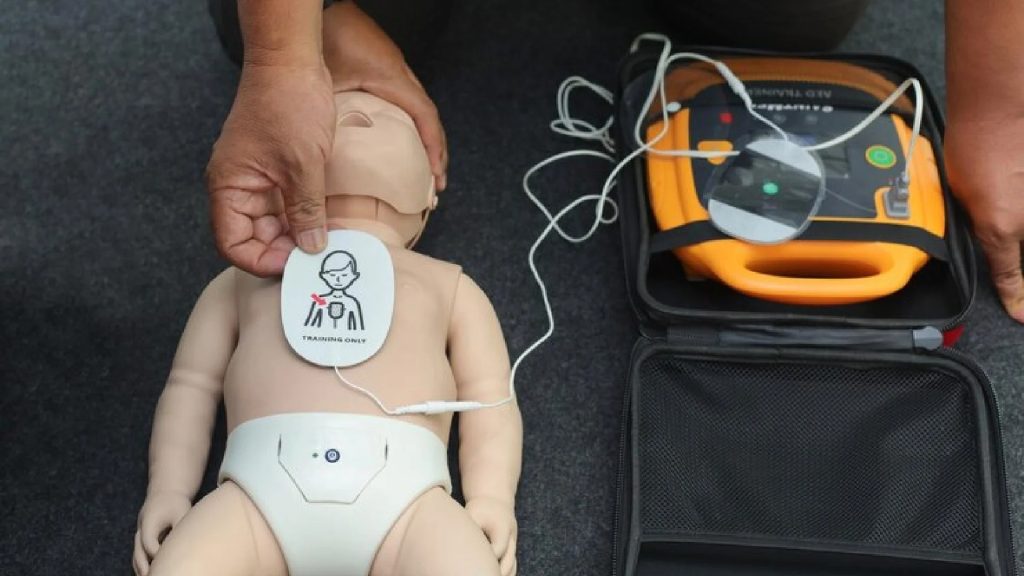
Place pads in an anterior/posterior position. Apply one pad to the center of the infant’s chest on the sternum. Place the other pad on the infant’s back between the shoulder blades. This placement is critical for effective current delivery and should always be used for infants.
The Science Behind AEDs: Safe for Infant Cardiac Arrest
Understanding how AEDs analyze infant heart rhythms helps explain their safety. Modern AED algorithms can accurately distinguish between shockable and non-shockable rhythms in all age groups.
Research testing AED diagnostic programs against pediatric arrhythmia databases shows high specificity and sensitivity. The devices correctly identify ventricular fibrillation and pulseless ventricular tachycardia while avoiding inappropriate shocks for other rhythms.
Initial concerns about AEDs misinterpreting rapid supraventricular tachycardia in infants as ventricular fibrillation have been addressed. Studies confirm that AED algorithms developed for adult arrhythmias work effectively in pediatric populations.
Emergency Response: When to Use an AED on an Infant
Recognizing cardiac arrest in infants requires immediate action. Signs include:
- Unresponsiveness
- Absence of normal breathing or only gasping
- No pulse detectable
When these signs are present, begin CPR immediately and have someone retrieve an AED. For infants, use two fingers for chest compressions at a depth of 1.5 inches. Provide 30 compressions followed by 2 rescue breaths.
As soon as the AED arrives, turn it on and follow the voice prompts. Apply the pediatric pads in the anterior/posterior position. Allow the device to analyze the rhythm. Stand clear during analysis and shock delivery. Resume CPR immediately after any shock.
Training for Infant AED Use
Proper training ensures effective emergency response. CPR Memphis offers comprehensive courses teaching infant resuscitation skills.
Our courses include:
- PALS (Pediatric Advanced Life Support) provides advanced training for healthcare professionals treating critically ill infants and children
- BLS for Healthcare Providers covers infant CPR and AED use essentials
- CPR and First Aid courses teach lifesaving skills to parents, caregivers, and community members
All classes are stress-free and hands-on. Students practice on infant mannequins with actual training AEDs. This realistic practice builds confidence for real emergencies.
Are AEDs Safe for Infant Cardiac Arrests? Final Thoughts
The evidence clearly shows that AEDs are safe and effective for infant cardiac arrest. While manual defibrillators remain the gold standard for infants, AEDs provide a viable and potentially life-saving alternative when manual devices are unavailable.
The key points to remember:
- AEDs can be safely used on infants of any age
- Pediatric pads with dose attenuators are preferred but not required
- The recommended initial dose is 2 J/kg
- Anterior/posterior pad placement is essential for infants
- Early defibrillation combined with high-quality CPR saves lives
Every infant cardiac arrest represents a time-critical emergency. Having an AED available and knowing how to use it can mean the difference between life and death. The safety profile of AEDs for infants, combined with their ease of use, makes them an essential tool in pediatric emergency care.
Take Action: Get Trained Today
Don’t wait until an emergency happens. Learn how to save a life through proper training.
Register for our courses today:
- AHA CPR course registration in Memphis – Learn infant CPR and AED use from certified instructors
- PALS Class in Memphis – Advanced pediatric life support training for healthcare providers
CPR Memphis is an American Heart Association training site offering initial certifications and renewals in BLS for Healthcare Providers, ACLS, PALS, and CPR and First Aid courses. All classes are stress-free and hands-on.
Contact CPR Memphis today to schedule your training. When you know what to do, you can be ready to act when seconds matter most.
Frequently Asked Questions About AED Safety for Infants
Can you use an adult AED on an infant if pediatric pads are not available?
Yes, you can use an adult AED on an infant if pediatric pads are unavailable. The American Heart Association confirms this is acceptable in emergency situations. Place the pads in anterior/posterior position – one on the center of the chest and one on the center of the back. Make sure the pads do not touch each other. Using an adult AED is better than not defibrillating at all when an infant is in cardiac arrest. The device will only deliver a shock if a life-threatening rhythm is detected. While pediatric pads are preferred because they reduce the energy delivered, adult pads have been used successfully without causing harm in documented cases.
At what age should you switch from pediatric to adult AED pads?
Switch from pediatric to adult AED pads at age 8 or when the child weighs more than 55 pounds (25 kg). The American Heart Association recommends pediatric pads for children under 8 years. After this age or weight threshold, use standard adult pads. For children right at the boundary, factors like body size matter more than exact age. Larger children approaching puberty should use adult pads. The key is ensuring pads make good contact with the chest and do not overlap. Most AEDs provide clear guidance about which pads to use. When in doubt, using either pad type is better than not using the AED at all.
What happens if you use the wrong joules on an infant during defibrillation?
Studies show that while optimal dosing provides the best outcomes, infants have survived defibrillation with energy doses outside recommended ranges. Research documents safe and effective AED use in infants when doses exceeded 2-4 J/kg. However, evidence indicates that doses significantly higher than 2.5 J/kg are associated with lower survival rates. The body can tolerate some variation, but staying within guidelines gives infants the best chance of survival. This is why pediatric attenuators are preferred – they automatically deliver appropriate energy levels. In emergencies, using available equipment is more important than waiting for perfect equipment. The AED’s rhythm analysis ensures shocks are only delivered when truly needed.